| MAGIC VOICE | Hardware |
![]() |
Allgemeines General |
Einführung Introduction |
Anschluss Connection |
Anwenden des Moduls Using the Module |
Vokabular Vocabulary |
Tips & Tricks Tips & Tricks |
| Ergänzendes Additional stuff |
Demos Demos |
Spiele Games |
Zeitschriften Magazines |
Sprach Downloads Speech Downloads |
Lexikon Lexicon |
|
| Internes Internal |
Hardware Hardware |
Firmware Firmware |
Sprachdaten Speechdata |
Bit-Format Bit allocation |
De-/Codierung De-/Coding |
|
| Nützliches und mehr Utilities and more |
Speech Playtool | Magic Game Cart | Magic Talkie | Magic Voice NT | Ersatzteile & Reparatur Spares & Repair |
|
Die Hardware des Magic Voice Moduls. |
The Hardware of the Magic Voice Module. |
| Hard- und Softwareversionen - Hard- and Software versions |
|
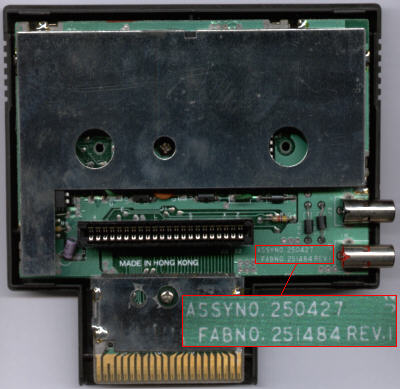
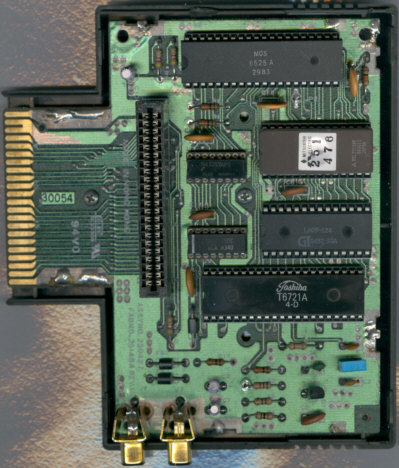
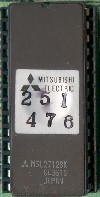
Das Magic Voice Modul gibt es nur in einer Hard- und Softwareversion. Die Platine ist mit ASSYNO. 250427, FABNO. 251484 REV.1 gekennzeichnet. Das EPROM hat die MOS-Nummer 251476. |
There exists only one hard- and software version of the Magic Voice Module. The board is labeled with ASSYNO. 250427, FABNO. 251484 REV.1 The EPROM has the MOS number 251476. |
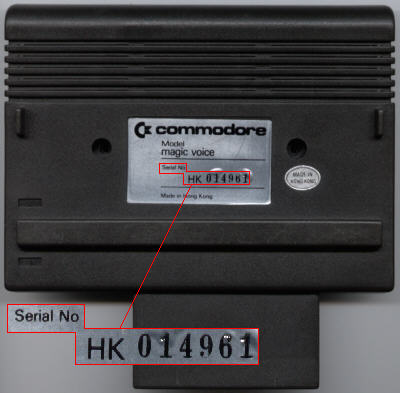
Seriennummer - Serial number![]() |
Hardwareversion![]() |
| Die Seriennummer des Moduls steht auf der Gehäuseunterseite. The serial number can be found at the bottom of the module. |
Die Angaben zur Hardware sind auf der Platine aufgedruckt. The information about the hardware is printed on the circuit board. |
|
Offensichtlich wurden auch eine ganze Menge Module ohne jegliche Seriennummer verkauft. Versionen: (Tabelle sortiert nach Seriennummer) Ein + bedeutet, dass alle großen ICs (T6721/6525/EPROM/LA05) gesockelt sind. |
Obviously, a lot of modules have been sold without any serial number. Versions: (Table sorted by serial number) A + indicates that all major ICs (T6721/6525/EPROM/LA05) are socketed. |
| Modul | Sockel | . |
| Serial No. | Sockets | Bemerkung - Remark |
| ? | ? | Lowest known Ser.No. |
| HK 001393 | + | . |
| HK 010839 | + | Jogi |
| HK 010915 | + | sauhund |
| HK 014961 | + | Stefan67 |
| ? | ? | Highest known Ser.No. |
| Label fehlt - without label | + | |
| Label fehlt - without label | - | Jogi, alle großen ICs ursprünglich eingelötet, selbst mit Sockeln versehen |
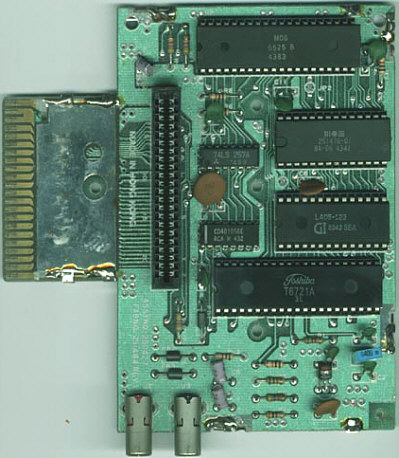
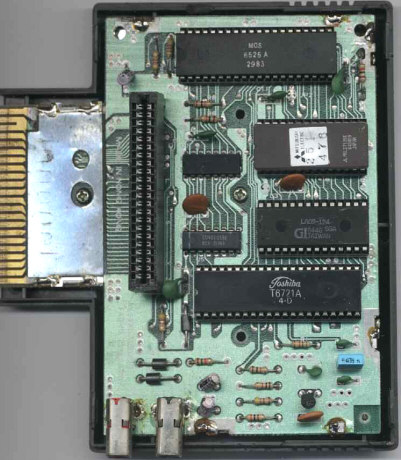
| Blick in das Innere - View inside |
![]() |
![]() |
![]() |
| Bild: Danny O'Day Quelle: Secret Weapons of Commodore |
Bilder: Joachim Nemetz Quelle: VIC20.de - Magic Voice |
|
| 6525 B, LA05-123, MOS-ROM | 6525 A, LA05-124, 27128 Eprom | 6525 A, LA05-124, 27128 Eprom |
| Ab einer bestimmten Seriennummer wurden die großen ICs nicht mehr gesockelt. Ein weiterer Unterschied ist die Bestückung mit einem MOS-ROM oder Eprom. Der LA05 ist in der Version -123 und -124 vorzufinden. Der MOS 6525 wurde als A und B Version verbaut. | From a specific serial number, the large ICs were not socketed anymore. Another difference is the assembly with a MOS-ROM or EPROM. The LA05 is to be found in version -123 and -124. The MOS 6525 was installed as the A and B version. |
| Schaltplan und Bauteile - Schematic and components |
Version 0.96.a - 22. August 2012 - Joachim Nemetz (294 KB)
Version 0.97a - 02. September 2012 - Stefan Uhlmann (24 KB)| Stück Quantity |
Ref. | Wert/Typ Value/Type |
Gehäuse Housing |
Bezeichnung Designation |
Bemerkung Remark |
| 1 | U1 | CD40105BE | DIP 16 | FIFO register | 4-bit x 16-word FIFO register, also 74HCT40105 |
| 1 | U2 | MOS 6525 | DIP 40 | Tri-Port Interface (TPI) with interrupt control MOS and CSG |
6525A (2 MHz) = MOS 901343-01 6525B (3 MHz) = MOS 901979-03 |
| 1 | U3 | LA05-124 | DIP 28 | Uncommitted Logic Array | auch LA05-123, customer design |
| 0 | U4 | - | DIP 20 | - entfallen - dispensed - | U3 = PAL16L8 (adress decoder) and U4 = PAL16R4 (parallel-serial-converter) used in the prototype have been replaced with the mask programable Gate Array LA05 in the production unit |
| 1 | U5 | T6721A | DIP 42 | Speech Synthesizer | CMOS, Manufacturer: Toshiba America Electronic Components, Inc. T6721AP (DIP 42 pin) Part# 27901026 T6721AF (FLAT 56 pin) Part# 22117707 |
| 1 | U6 | MOS 251476 Eprom 27128 |
DIP 28 | Eprom | 251476-01, 16384 word x 8 bit, 16KB |
| 1 | U7 | 74LS257 | DIP 16 | Quad 2-Input Multiplexer | 901521-57, Vier 2 zu 1 Datenselektoren |
| 1 | Q1 | PN2222 | TO-92 | NPN Transistor | 902686-01 (2N2222, TO-18), General Purpose Transistor, FPN2222 |
| 1 | Y1 | 640 KHz | RM 5,08 mm | Keramik Resonator - Ceramic Resonator | 640 KHz, 2 Pin |
| 1 | R4 | 300 Ω | 0207 | Widerstand - Resistor | Kohleschicht - carbon composition, Baugröße: (DxL 2,3x6,0mm), 0,25 Watt, ±5% |
| 1 | R5 | 470 Ω | 0207 | Widerstand | |
| 1 | R3 | 1 kΩ | 0207 | Widerstand | |
| 3 | R9, R10, R11 | 4,7 kΩ | 0207 | Widerstand | |
| 1 | R1 | 5,1 kΩ | 0207 | Widerstand | |
| 5 | R2, R6, R7, R8, R12 | 10 kΩ | 0207 | Widerstand | |
| 2 | C1, C2 | 100 pF | RM 5,08 mm (*1) | Kondensator - Capacitor | Keramik - Ceramic |
| 4 | C3, C9, C11, C13 | 10 nF | RM 5,08 mm | Kondensator | Keramik |
| 1 | C4 | 6,8 nF | RM 5,08 mm | Kondensator | Keramik |
| 3 | C5, C6, C12 | 100 nF | RM 5,08 mm | Kondensator | Keramik |
| 1 | C8 | 0,47 μF | RM 5,08 mm | Kondensator | Elektrolyt - Electrolytic |
| 2 | C7, C10 | 10 μF | RM 5,08 mm | Kondensator | Elektrolyt |
| 3 | FB1, FB2, FB3 | Z @ 10MHz 28Ω | - | Ferritperle - Ferrite Bead | EMV Ferrit-Entstörfilter axial, ø 3,5 x 4,5 mm |
| 1 | J1 | - | Modulschacht - Cartridge Slot | Card Edge Slot Connector 44 pin, Modul-Port des Magic Voice 2x22 Pin, RM = 2,54 mm / 0,100" |
|
| 2 | J2, J3 | - | Audio Buchse - Audio Socket | Cinch RCA Buchse, RCA Jack J2 = IN = red, J3 = OUT = black |
|
| Integrierte Schaltungen - Integrated circuits |
T6721A (1679 KB)
MOS_6525 (884 KB)
GI_ULAs (938 KB)
-

M5L27128K (396 KB)
40105 (201 KB)
SN74LS257 (76 KB)
PN2222 (26 KB)| 6525 Tri-Port Interface |
|
Das Tri-Port Interface verfügt über zwei Betriebsmodi: Modus 0: Drei 8-Bit I/O-Ports (= 24 individuell programmierbare I/O-Leitungen) Modus 1: Zwei 8-Bit I/O-Ports (= 16 individuell programmierbare I/O-Leitungen) und 5 prioritäts Interrupt-Eingänge, einen Interrupt Meldeausgang und 2 steuerbare Handshake-Leitungen Im Magic Voice wird das Interface im Modus 1 betrieben. Die Zellen in der Tabelle sind mit Hintergrundfarbe wie folgt gekennzeichnet: C64-Adresse blau, Eingang grün, Ausgang rot, Unbenutzt dunkelgrau |
The TRI-port interface has two operating Modes: Mode 0: Three 8-bit I/O ports (= 24 individually programmable I/O lines) Mode 1: Two 8-bit I/O ports (= 16 individually programmable I/O lines) and 5 priority interrupt inputs, an interrupt signalling output and 2 controllable handshake lines In the Magic Voice the interface is used in Mode 1. The cells in the table are marked with background color as follows: C64-Address blue, Input green, Output red, Unused dark grey |
| C64-Adresse | Bit 7 | Bit 6 | Bit 5 | Bit 4 | Bit 3 | Bit 2 | Bit 1 | Bit 0 | Bemerkung |
| $DF80 | PA 7 | PA 6 | PA 5 | PA 4 | PA 3 | PA 2 | PA 1 | PA 0 | PRA - Port Register A |
| Function: | Status DIR |
Status /EOS |
/GAME | SI | D3 | D2 | D1 | D0 | OUT: D0..D3 Data through 40105/LA05 to T6721 (highest Nibble first) OUT: SI = Shift in to FIFO (L->H "Pretty Please") IN: /GAME of the MV-Modulport IN: /EOS = End of Speech from T6721 IN: DIR = Data in Ready from 40105 |
| $DF81 | PB 7 | PB 6 | PB 5 | PB 4 | PB 3 | PB 2 | PB 1 | PB 0 | PRB - Port Register B |
| Function: | /EXROM | ? | ? | /WR | D3 | D2 | D1 | D0 | OUT: D0..D3 Data to T6721 (highest Nibble first) OUT: /WR to T6721 (L->H "Pretty Please") OUT: ? PB 5 OUT: ? PB 6 IN: /EXROM of the MV-Modulport |
| $DF82 | (PC 7) CB |
(PC 6) CA |
(PC 5) /IRQ |
(PC 4) IL 4 |
(PC 3) IL 3 |
(PC 2) IL 2 |
(PC 1) IL 1 |
(PC 0) IL 0 |
(Mode 0: PRC - Port Register C) Mode 1: Handshake and Interrupt Latches |
| Function: | /EXROM | 0=RAM 1=EPROM |
C64 /NMI |
- | Data in Ready | End of Speech | - | - | Bit 0..4 Interrupt Inputs, Bit 5..7 Outputs IN: /EOS IN: DIR OUT: /NMI (automatically generated if /EOS or DIR occurs) OUT: ? CA OUT: /EXROM of the C64-Port |
| $DF83 | DA 7 | DA 6 | DA 5 | DA 4 | DA 3 | DA 2 | DA 1 | DA 0 | DDRA - Data Direction Register Port A |
| Value: | 0 | 0 | 0 | 1 | 1 | 1 | 1 | 1 | 0=Input, 1=Output ($1F) |
| $DF84 | DB 7 | DB 6 | DB 5 | DB 4 | DB 3 | DB 2 | DB 1 | DB 0 | DDRB - Data Direction Register Port B |
| Value: | 0 | 1 | 1 | 1 | 1 | 1 | 1 | 1 | 0=Input, 1=Output ($7F) |
| $DF85 | DC 7 - |
DC 6 - |
DC 5 - |
DC 4 M 4 |
DC 3 M 3 |
DC 2 M 2 |
DC 1 M 1 |
DC 0 M 0 |
(Mode 0: DDRC - Data Direction Register Port C) Mode 1: Interrupt Mask Register |
| Value: | - | - | - | 0 | 1 DIR |
1 EOS |
0 | 0 | (Mode 0: 0=Input, 1=Output) Mode 1: 0=Mask, 1=Enable |
| $DF86 | CB 1 | CB 0 | CA 1 | CA 0 | IE 4 | IE 3 | IP | MC | CR - Control Register |
| Value: | 1 | X | 1 | X | 0 H->L |
1 L->H |
X | 1 Mode 1 |
MC=Mode Control, IP=Priority Operation, IE=Edge Selection (for IE 0 .. 2 always H->L) |
| 0 | 0 | 0 | 0 | CA, see Datasheet | CB, see Datasheet | The outputs CA (PC6) and CB (PC7) are controlled by this Register. CA is controlled by CA 0 and CA 1 CB is controlled by CB 0 and CB 1 CA 1 and CB 1 are always 1. Therefore the output CA = CA 0 and CB = CB 0. |
|||
| 0 | 1 | 0 | 1 | CA pulses Low after reading PRA | CB pulses Low after writing PRB | ||||
| 1 | 0 | 1 | 0 | CA = Low | CB = Low | ||||
| 1 | 1 | 1 | 1 | CA = High | CB = High | ||||
| $DF87 | - | - | - | AI 4 | AI 3 | AI 2 | AI 1 | AI 0 | AIR - Active Interrupt Register |
| Value: | - | - | - | 0 | DIR | EOS | 0 | 0 | |