| MAGIC VOICE | Tipps & Tricks - Tips & Tricks |
![]() |
Allgemeines General |
Einführung Introduction |
Anschluss Connection |
Anwenden des Moduls Using the Module |
Vokabular Vocabulary |
Tipps & Tricks Tips & Tricks |
| Ergänzendes Additional stuff |
Demos Demos |
Spiele Games |
Zeitschriften Magazines |
Sprach Downloads Speech Downloads |
Lexikon Lexicon |
|
| Internes Internal |
Hardware Hardware |
Firmware Firmware |
Sprachdaten Speechdata |
Bit-Format Bit allocation |
De-/Codierung De-/Coding |
|
| Nützliches und mehr Utilities and more |
Speech Playtool | Magic Game Cart | Magic Talkie | Magic Voice NT | Ersatzteile & Reparatur Spares & Repair |
|
Tipps, Tricks und weitere Ideen ... Spielereien mit dem Magic Voice Modul. Software Hardware-Basteleien |
Tips, Tricks and more Ideas ... Playing Around with the Magic Voice Module. Software Hardware Tinkering |
| Bekannte Fehler - Known Bugs |
| Es sind keine Fehler beim Magic Voice Modul bekannt. Beim V364 erhält man bei SAY "TY" eine Fehlermeldung, stattdessen kann man SAY 20 verwenden. | On the Magic Voice module there are no errors known. On the V364 you get an error, when using the command SAY "TY", use SAY 20 instead. |
| Programmierung - Programming |
|
"?ILLEGAL QUANTITY ERROR" verhindern. Dies ist einer der häufigsten Fehler. Er tritt dann auf, wenn man mit "SAY" ein Wort aufruft, das nicht im Vokabular des Moduls enthalten ist. Mit den folgenden POKEs kann man den Fehler umleiten. |
Avert "?ILLEGAL QUANTITY ERROR". This is one of the most common errors. This error occurs when the user tries to "SAY" a word, that is not in the modules vocabulary. With the following POKEs the Error can be diverted. |
| Verwendung eines Emulators - Using an emulator |
|
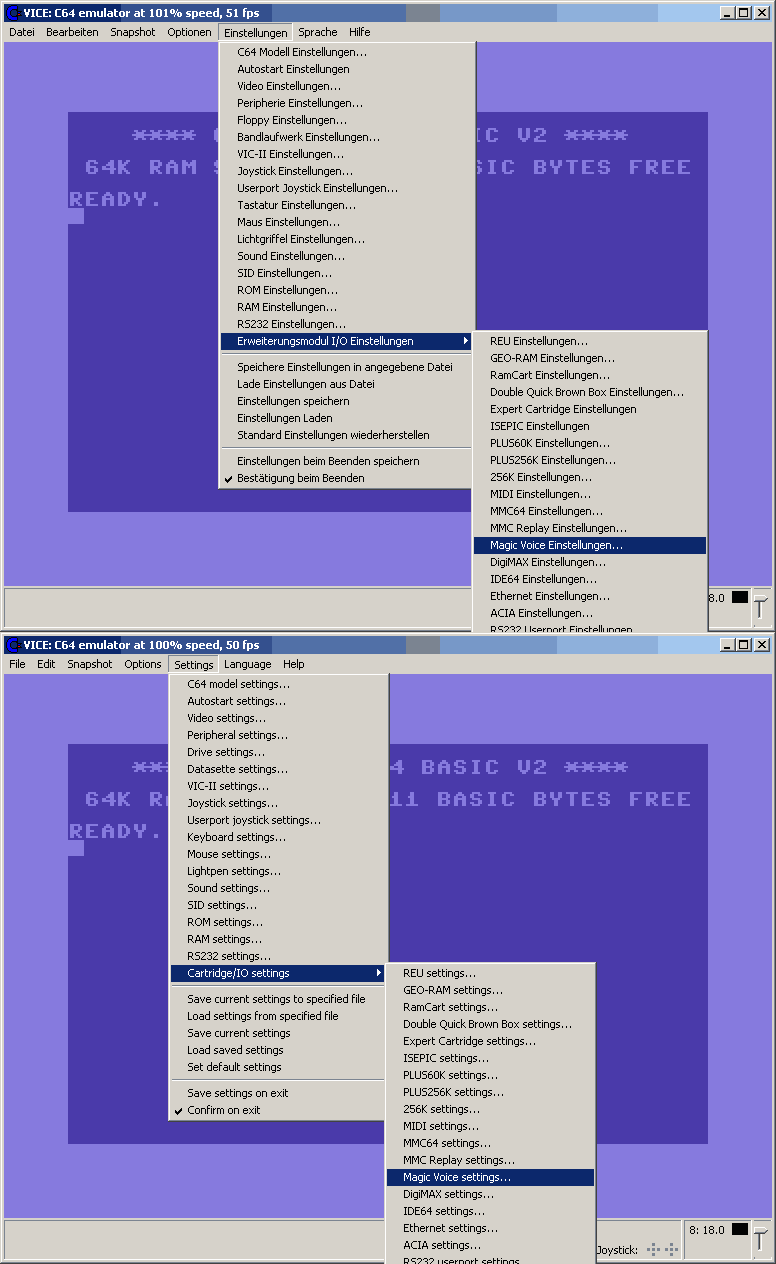
Mit der C64 Emulation des VICE ist es möglich, das Magic Voice Modul zu emulieren.
Hierfür wird die Version 2.3 vom 26. Februar 2011 oder höher benötigt. 1. Magic Voice aktivieren |
With the C64 emulation of VICE it is possible to emulate the Magic Voice Module.
You need Version 2.3 released on 26 February 2011 or higher. 1. Enable Magic Voice |
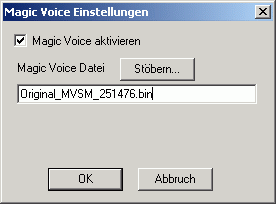
Aktivieren:![]() Die Datei Original_MVSM_251476.bin kann auf der Firmware-Seite heruntergeladen werden. |
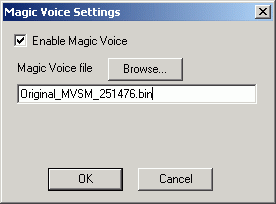
Enable:![]() The File Original_MVSM_251476.bin can be downloaded at the Firmware-Page |
|
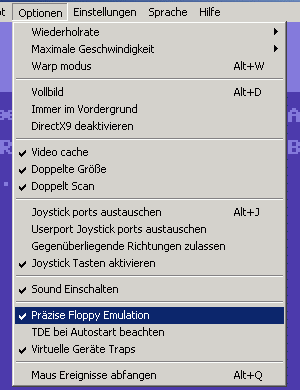
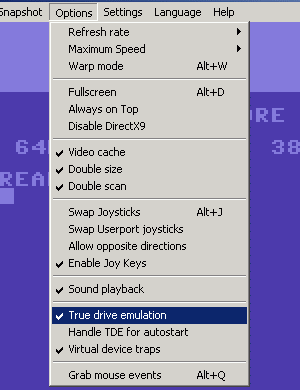
2. Präzise Floppy Emulation Aus irgendeinem Grund funktioniert das Magic Voice bzw. der Emulator nur richtig, wenn die Floppy Emulation eingeschaltet ist.
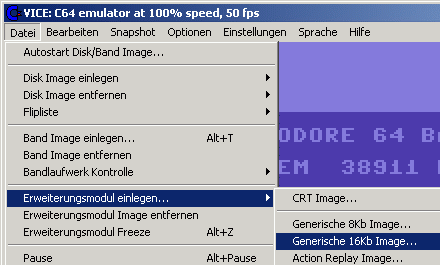
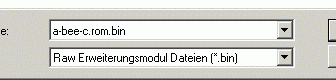
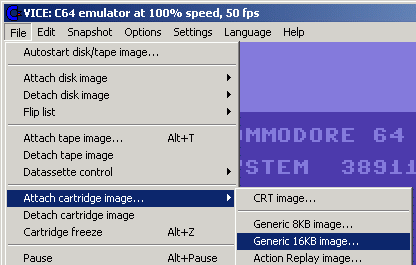
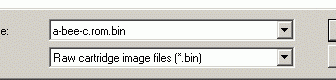
Das war schon alles. Hinweis: Wen man die Einstellungen bei VICE speichert, ist das Magic Voice auch nach dem Neustart noch eingesteckt. Bei Konflikten mit anderen Programmen besser wieder deaktivieren. Um ein Modul in das Magic Voice einzustecken, geht man wie folgt vor: Die ROM-Datei (siehe Spiele-Seite) des Spiels einlegen. ![]() ![]() Hinweis: Mit den Modulen "Wizard of Wor" und "Gorf" funktioniert die Emulation noch nicht (VICE 2.3). Mit "A Bee C's" kommt es an manchen Stellen zum einfrieren des Spiels |
2. True Drive Emulation For any reason the Magic Voice respectively the emulator works correct only, if the floppy emulation is activated.
That was it already. Note: If you save the settings in ViCE, than is the Magic Voice still attached after restart. If you have conflicts with other programs, it is advisable to disable it. To insert a cartridge into the Magic Voice, you have to do the following: Attach the ROM-File (see Games-Page) of the Game. ![]() ![]() Note: With the cartridges "Wizard of Wor" and "Gorf" does the emulation not work yet (VICE 2.3). With "A Bee C's" it happens, that the game freezes on certain positions. |
|
Mit der V364 Emulation des YAPE ist es möglich, die Sprachfunktion des Magic Voice Moduls zu emulieren. Hierffür wird die Version 0.68 vom 10. September 2006 oder höher benötigt. |
With the V364 emulation of YAPE it is possible to emulate the speechfunctions of the Magic Voice Module. You need Version 0.68 released on 10 September 2006 or higher. |
| Audioverstärker - Audio Amplifier |
|
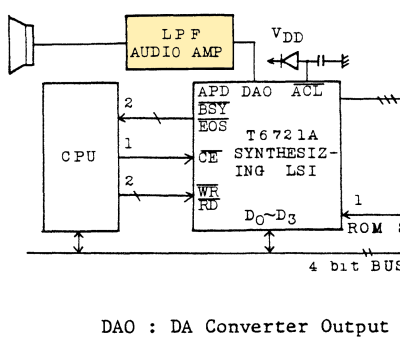
Der Cinch-Ausgang (RCA) des Magic Voice Moduls ist dafür ausgelegt, um an einen Monitor oder Verstärker angeschlossen zu werden. Ein Ausgang zum direkten Anschluss an einen Lautsprecher ist nicht vorgesehen. Nicht nur im Datenblatt des T6721 ist am Audioausgang (Pin 8: DAO) des ICs ein LPF (Low Pass Filter) und ein AMP (Amplifier) skizziert. Man findet das in fast allen Datenblättern von Sprach- oder Soundchips. Manchmal ist es mit einem Schaltplan detailiert beschrieben. |
The RCA output of the Magic Voice module is designed to be connected to a monitor or amplifier. There is no output for direct connection to a speaker. It's not just in the T6721 data sheet that an LPF (low-pass filter) and an AMP (amplifier) are shown at the IC's audio output (Pin 8: DAO). This is found in almost all data sheets for voice or sound chips. Sometimes it is described in detail with a circuit diagram. |
|
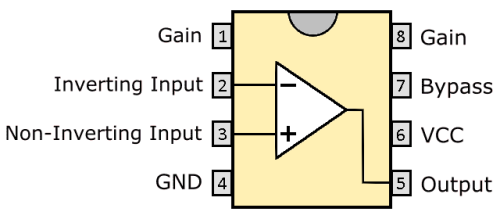
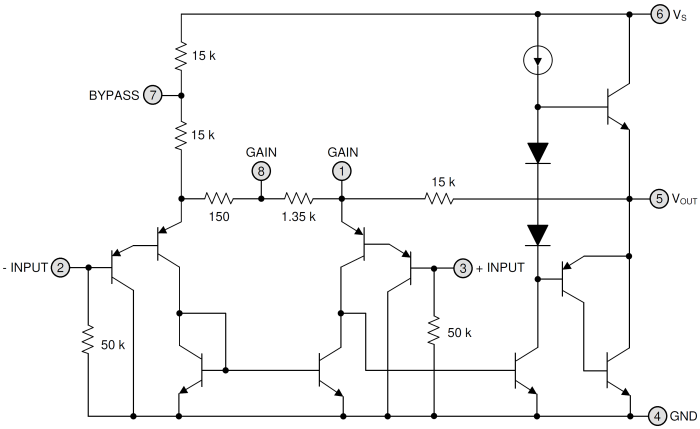
Um einen Audioverstärker aufzubauen, eignet sich das bereits in den 1970er Jahren eingeführte Verstärker-IC LM386. Der LM386 ist bis heute ein extrem populäres analog Mono-Audio-Leistungsverstärker-IC.
Es zeichnet sich dadurch aus, dass für den Betrieb nur sehr wenige externe Bauteile benötigt werden. |
For building an audio amplifier, the LM386 amplifier IC, which was introduced back in the 1970s, is well-suited. The LM386 remains an extremely popular analog mono audio power amplifier IC to this day.
It is notable for requiring very few external components to operate. |
|
Anschlussbelegung, Pin Configuration
|
IC-Schaltplan, IC-Schematic
|
| Fortsetzung folgt ... | to be continued ... |
| Digital Analog Wandler - Digital Analog Converter |
|
Das Datenblatt des T6721 verschweigt, dass die digitalen Sprachdaten, so wie sie dem im Sprachchip eingebauten Digital-Analogwandler zugeführt werden, auch in serieller Form an einem Ausgang verfügbar sind. Die Parcor-Koeffizienten werden innerhalb des T6721 zunächst decodiert und sind dann 10-Bit breit. Danach durchlaufen sie ein 10-stufiges Lattice Filter mit 15-Bit Breite und werden an dessen Ausgang zu digitalen Sprachdaten. Eine Spitzenwert-Begrenzungsschaltung reduziert diese 15-Bit dann zu 9-Bit Breite und führt sie einem Digital-Analog-Wandler zu. Der Digital-Analog-Wandler des T6721A basiert auf einem R/2R Widerstandsnetzwerk. |
The T6721 datasheet fails to mention that the digital voice data — as it is fed to the digital-to-analog converter built into the voice chip — is also available in serial form at an output. The Parcor coefficients are first decoded within the T6721 and are then 10 bits wide. After that they pass through a 10-stage lattice filter with a 15-bit width and are converted into digital speech data at the filter’s output. A peak-limiting circuit then reduces this 15-bit width to 9 bits and feeds it to a digital-to-analog converter. The digital-to-analog converter in the T6721A is based on an R/2R resistive ladder network. |
|
Da der Synthesizer über einen 15-Bit-Digitalausgang verfügt, kann durch den Einsatz eines externen D/A-Wandlers eine höhere Qualität der Sprachausgabe erzielt werden. |
Since the synthesizer has a 15-bit digital output, using an external D/A converter can result in higher-quality voice output. |
|
Schaltung zur Erfassung der binären 10(15?)-Bit-Sprachdaten: Seriell zu Parallel (10-Bit): 1 x 74LS04, 1 x 74LS32, 2 x 74LS164 Binär zu Analog: 1 x AD7533 (10-Bit) |
Circuit for acquisition of 10(15?)-Bit binary speech data: Serial to Parallel (10-Bit): 1 x 74LS04, 1 x 74LS32, 2 x 74LS164 Binary to Analog: 1 x AD7533 (10-Bit) |
| Fortsetzung folgt ... | to be continued ... |
| Änderung der Oszillatorfrequenz - Changing the Oscillator Frequency |
|
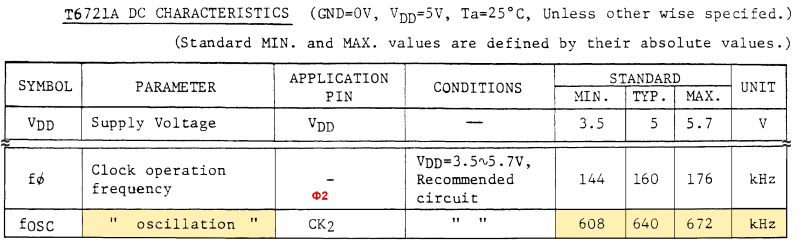
Für den Oszillator (Schwingkreis) des T6721 wird ein Keramik Resonator mit 640 kHz verwendet. Aus dieser Oszillatorfrequenz wird die Systemtaktfrequenz Φ2 von 160 kHz gebildet. Messbar ist die Systemtaktfrequenz am Ausgangspin 10 des T6721. Im Datenblatt sind die minimale, typische und maximale Oszillatorfrequenz angegeben. |
A 640 kHz ceramic resonator is used for the oscillator (resonant circuit) of the T6721. This oscillator frequency is used to generate the system clock frequency Φ2 of 160 kHz. The system clock frequency can be measured at output pin 10 of the T6721. The data sheet specifies the minimum, typical, and maximum oscillator frequency. |
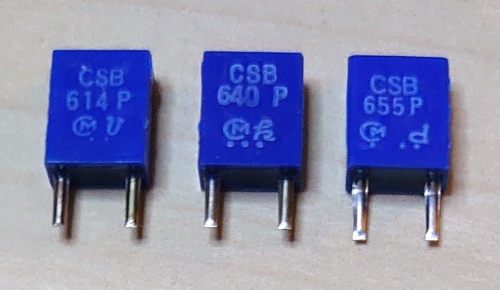
| Um zu sehen (hören), wie sich die Sprache (Geschwindigkeit/Tonhöhe) ändert, kommen Resonatoren mit den Frequenzen 614 kHz , 640 kHz und 655 kHz zum Einsatz. Unter der Annahme, dass die Bautteiltoleranz nicht mehr als 1 % (üblich 0,5 %) beträgt, ist das noch im Bereich der Spezifikation (614 - 1% = 608 , 655 + 1% = 661). | To see (hear) how the speech (speed/pitch) changes, resonators with frequencies of 614 kHz, 640 kHz, and 655 kHz are used. Assuming that the component tolerance is no more than 1 % (usually 0.5 %), this is still within the specification range (614 - 1% = 608, 655 + 1% = 661). |
| Fortsetzung folgt ... | to be continued ... |